With info-biorhythm Brazil 2026, thedotgood introduces its first Informational Health Check, run over the Brazilian Social Good Sphere.
A funder weighing a grant, a partner preparing an agreement, a journalist checking a claim: each wants a current picture of an organization. Its annual report tells what it does, for whom and to what effect. Its audited financial statements show the resources behind that work. When those documents become public matters.
thedotgood calls it info-biorhythm: how timely and how consistently a Social Good Organization makes its key reporting documents public after its fiscal year-end. It is one dimension of thedotgood‘s Informational Health Check. Brazil is its first national benchmark.
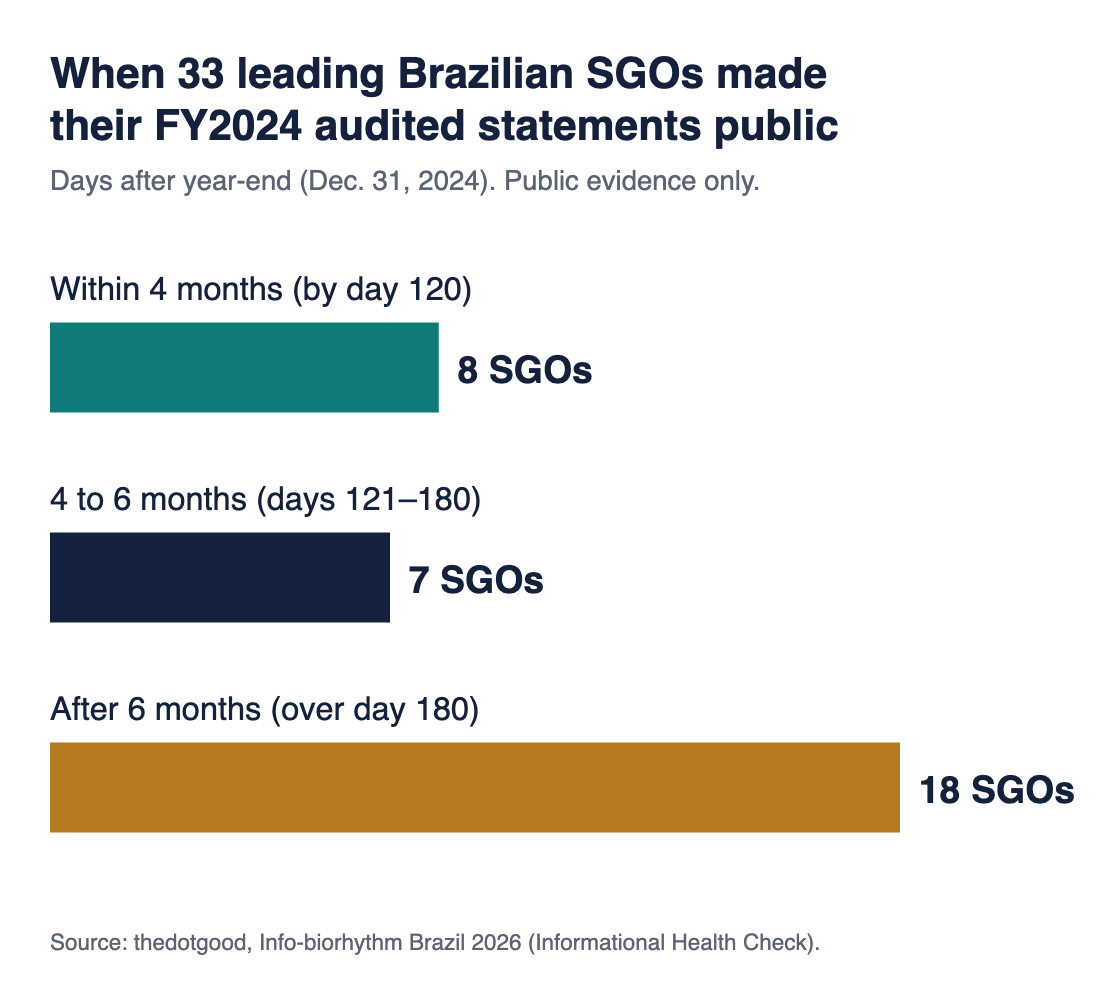
We reviewed 33 SGOs listed in thedotgood‘s 2026 Top 100 leading SGOs in Brazil, on fiscal year 2024, using public evidence only: the date each document first appeared on the organization’s own site or public channels.
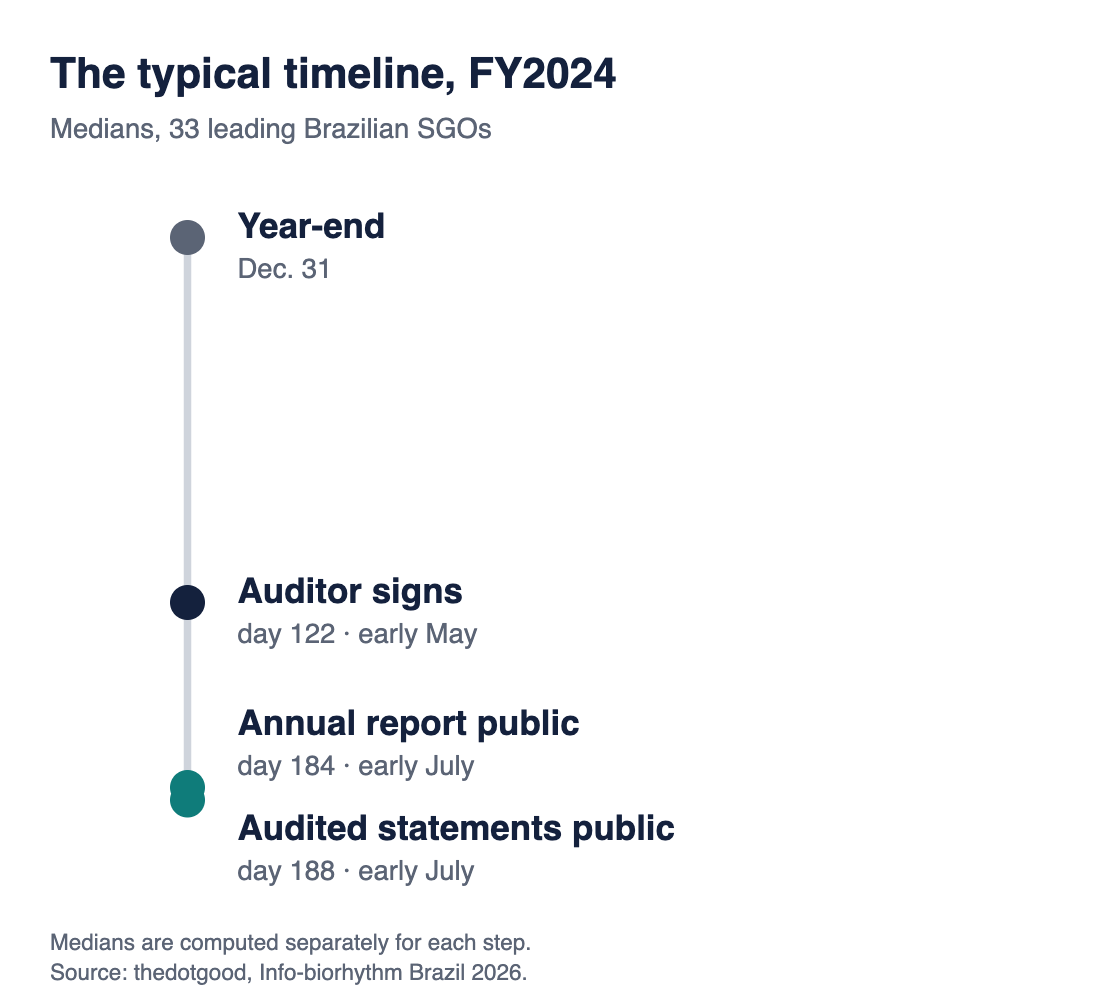
The auditor typically signs at the beginning of May. Once the audit is signed, publication tends to follow within about two weeks. Most of the time, then, goes into closing the books and completing the audit, not into putting the documents online.
Brazilian nonprofits, including the associations and foundations exempt from income tax, must file their tax return, the ECF, with the Federal Revenue Service by the end of July of the following year. That return is not made public. In the United States, by contrast, the equivalent return, the Form 990, is public by law: anyone can read it. Nothing prevents a Brazilian SGO from publishing its ECF. In practice, very few do. And for most associations and foundations, no law requires the annual report or the financial statements to be published, or sets a date for it.
The calendar makes the point. The typical SGO in the panel made its audited statements public at day 188, three weeks before the tax filing deadline. When an SGO shares its documents, and how soon, is largely its own choice. That choice is what info-biorhythm measures, and it leaves the Brazilian Social Good Sphere a real margin for progress.
Social Good Organizations call for public support and donors. Their discipline in making their key reporting documents public is paramount to making that call a success. It builds trust, and it shows how good they are at using their resources to deliver social profit. That is what it is all about.
As you read the full benchmark, see which SGOs are among the fastest to publish their key reporting documents: Info-biorhythm, Brazil 2026. The legal context is on our Brazil country page, and the method on About info-biorhythm.
The USA follows, under the same method. And SGOs in the Brazil panel can still improve their date: if a document first appeared online earlier than we found, send thedotgood the public link.
Enjoy the read.
In June 2012, The Global Journal commissioned an independent review of its own NGO ranking methodology — a candid, self-critical examination of how the Top 100 NGOs list was built, what it could and couldn’t claim, and where its real limitations sat.
Published in February 2013 and authored by Cecilia Cannon, then completing her PhD in Political Science/International Relations at Geneva’s Graduate Institute of International and Development Studies (IHEID), the paper situates the ranking within a broader shift: after decades of largely unquestioned goodwill, NGOs entered a period of genuine public scrutiny in the years following the 2010 Haiti earthquake, as their scale, credibility, and accountability came under closer examination.
The paper outlines four stated aims behind the ranking: to showcase the genuine diversity of organisations operating under the “NGO” label; to evaluate them comparatively, across geography and activity; to stimulate real debate around impact, innovation, and sustainability; and to track how the sector changes year over year.